Tag: Law

  • Least and Greatest in the Kingdom of Heaven

    Matthew 5:17-20

    1. “Do not think that I came to destroy (get rid of) the Law or the Prophets (prophecies). I did not come to destroy but to fulfill. For assuredly, I say to you, till heaven and earth pass away (after the Millennial Kingdom and the Great White Throne Judgement), one jot or one tittle will by no means pass from the law till all (all prophecies, including the end of Revelation with the destroying of the current Heaven and earth, and the creation of new ones where we will dwell for eternity) is fulfilled.
    2. Whoever therefore breaks one of the least of these commandments, and teaches men so, shall be called least in the kingdom of heaven; but whoever does and teaches them, he shall be called great in the kingdom of heaven.
    3. For I say to you, that unless your righteousness exceeds the righteousness of the scribes and Pharisees, you will by no means enter the kingdom of heaven.

    In point one, Christ tells us that He came to fulfill the law, which we later find out is on our behalf, that anyone who places their faith in Him receives His imputed righteousness. But He also mentions in this point that He does not abolish/get rid of the law – it still stands, just not for salvation.

    In point two, He tells us that those who obey the law and teach other believers to do so as well (again, not for salvation, but because its statutes are good and sums up the holiness of our Father who adopted us as His children) will be called great in the kingdom of heaven. And the opposite is true: while technically we can choose not follow the law and teach other believers that they don’t have to either (because we’re no longer under the law for salvation and that we’re saved by grace and not by works), for doing that we will be called least in the kingdom of heaven.

    In point three, He makes an interesting point: that unless our righteousness exceeds that of the scribes and Pharisees, we cannot enter the kingdom of God. The Pharisees were known for the most stringent perfection of law keeping, and not even they were good enough? We have to be more perfect than they? What Jesus is doing here is elevating the standard of the requirement of law keeping for salvation to perfection, naturally leading people to the question: “Well who can be saved then? Since no one can keep the law that perfectly – not even the Pharisees.” Christ partially gave the answer in part one: He will fulfill the law, and we learn later in the epistles of Paul (primarily Romans) that we all fall short of the law’s standard, and the only way to achieve the righteousness that God requires (point three: a righteousness greater than the Pharisees) to enter into the kingdom of heaven is to get the imputed righteousness of Christ that comes by faith in Him alone – not by working the law.

    And again, in points one and two, while we’re no longer saved by following the law, the law hasn’t been abolished (ie: murder and lying isn’t all the sudden ok), and we’re still to uphold it because we agree that its statutes are good (not murdering is good. Not stealing is good), and if we choose not to obey the law and teach others they don’t need to follow it either because we’re saved by grace and not by law keeping, we will be called least in the kingdom of heaven.

    Why do we still follow the law if we’re no longer under the law for salvation? Because it’s good, and its statutes bring true joy, peace and freedom (and the entire point of life is to feel peace and joy): it’s good not to murder. It’s good not to lie. It’s good not to steal. It’s good not to commit adultery, etc. The law sums up our Father’s holiness. He adopted us as His children, and like any good Father, He wants His children to grow up to be like Him. It’s like adopting a teenager who was in a street gang. You would want to teach him that the gang is not good, and would want him to separate from the gang. You would teach him good ways (the law) and would want him to start living a good, honorable life. Like Father, like son.

    We uphold the law because it’s good, but we’re not saved by keeping it.
  • Freed From the Law and Sin (Romans, chapters 3-8)

    This note explains the somewhat confusing and complicated chapters of Romans 3-8.

    The first thing to understand is the dichotomy of the inner man vs the outward man. A brief overview: we are actually a soul, that has a spirit, and lives inside our fleshly body. For more details, see the note: The Inner Man vs the Outward Man (opens in a new window)

    The next thing to understand is that “sin” is not just some abstract concept or idea. It’s a literal living thing that lives in our fleshly bodies:

    • Sin “entered” the world when Adam ate of the forbidden fruit. (Romans 5:12)
    • Sin “lives” in our fleshly bodies. (Romans 7:17-18; Romans 7:20; Romans 7:21-23)

    What is a law?
    When you’re under a law, you must obey it. If the law says, “You shall not steal”, then you cannot steal. And with laws, there’s consequences for going against it. For the law (the 10 commandments), it’s condemnation and death with eternal hellfire.

    What is a master-slave relationship?
    Likewise, if we were under bondage as a slave to a master, the slave must obey their master. If the master says, “Steal”, then you must steal.

    What is the rule about being under laws?
    The rule that God instantiated about laws is that when you die, you are released from the law you were under.

    The same goes for master-slave relationships. When you die, you are no longer the slave of the master you were owned by.

    We are all born under the law, and sin quickly becomes our master. As slaves of our master (sin) we obey its commands to break the law. And when we break the law, we are condemned to death and eternal hellfire as just punishment.

    So the question is: “If we get freed from laws and masters by death, how do we get freed from the law (the commandments) and our master (sin)?” The answer: we must die, and then we will be released from our master (sin), and from the law that condemns us. Here’s how we “die”:

    For this next part, you must understand the gospel: 1 Corinthians 15:1-4 — that Christ (1) died to pay for all our sins (2) was buried and (3) rose again the third day.

    The next logical question is: “How do we die?” The answer: when we believe the gospel, we are spiritually crucified with Christ. It is like our body/flesh was literally put to death on the cross (the gospel: step 1). So there, we just died (and the sin within us along with us). The moment we believed the gospel, our flesh died and we were released from our former master (sin), and from the law that condemned us when we sinned. Our dead outward bodies and the sin within were then buried (the gospel: step 2), and we as our inner man was spiritually reborn of incorruptible Seed and raised back to life (the final gospel step 3), and now our new selves are now slaves to God and are under His law of grace. All this is what’s meant by being baptized (following Christ) into Christ’s death, burial and resurrection.

    So, Christ redeemed us (freed us) from our master (sin), as well as the law that condemned us when we sinned, when we believed in His death on the cross (for the payment for our sins), His burial and His resurrection. And that believing He did that for us, we are then baptized (following Him) into His death, being set free from sin and the law, and are raised to new life under our new master (God) and His law of grace.

    We are now a slave of our new Master, God, who redeemed (freed) us from our old master, sin. What does God command us to do? He commands us to believe the gospel for salvation, and to “be holy”: “Be holy, for I am holy”. (If I’m saved by faith, why be holy? See note on: The Ways of God vs the Ways of the World [The best note on this site. Opens in a new window])

    And not only are we God’s slave now, we are now also under the law of grace, being set free (redeemed) from the former law that condemned us. What does the law of grace say? It says: “If you do sin and break the other law, you are forgiven instead of condemned.”

    And just because we’re now under the law of grace (forgiveness) instead of the law of condemnation, it doesn’t mean that we should use that as an excuse to let our flesh sin and break the old law. We absolutely could, but we are told not to. Instead of totally disregarding the old law, we uphold it because we agree that its statutes are good (it’s good not to steal, it’s good not to murder, it’s good not to lie, etc.). We’re just not condemned by it when our flesh does break it, because we’re no longer under it, as we’re now under the law of grace.

    Now, there’s the spiritual reality of our flesh being dead, but then there’s also the physical reality: that our flesh is not dead yet and is very much alive and sin still lives in it. But we’re to reckon/consider/pretend our flesh to be dead, which means that we are free from our former master (sin), and since we’re no longer sin’s slave, we no longer obey it when it tells us to sin. We are to act/behave as if our sinful flesh is actually dead and deprive our flesh of its desire to sin. Instead, we obey our new Master (God), who commands us to be holy. And when our flesh overtakes us and we fail to be holy in the flesh, remember, we are no longer under the old law that condemned us for it, we are now under the law of grace that forgives us.

    Does “being dead to sin” mean that we won’t sin anymore? No. Remember, spiritually we’re dead to sin, but the physical reality is that our sinful flesh is still alive and desires to sin. We’re simply to pretend it’s dead and deprive it of its desire to sin to the best of our ability. See this note on how to do this: The Ways of God vs the Ways of the World (The best note on this site. Opens in a new window)

    Even Jesus (God) took on human nature and had a fleshly body with sin in it. But since He was also God within that flesh, He was able to deprive that sin of its desires, thus fulfilling the law (something us humans couldn’t do). (Romans 8:3)

    On the cross, God the Father put all our sin in Christ’s fleshly body. Jesus bore our sin in His flesh on the cross, and God put His body/flesh to death, along with all our sins in it: 1 Peter 2:24 — “who Himself bore our sins in His own body on the tree (the cross), that we, having died to sins, might live for righteousness—by whose stripes (wounds) you were healed.”

  • Why the Law Was Given

    The law (the 10 commandments) was not given to save people by following it. It was given to:

    1. Show us what is right and wrong morally.
      1. Paul says in Romans 7:7 that he would not have known what coveting was unless there was a law that said, “You shall not covet.”
      2. Galatians 3:19.
    2. Hold us all accountable (make us guilty) before God.
      1. Galatians 3:22.
      2. Romans 3:19.
      3. As a just and fair God, He has to have something to judge us by if we don’t place our faith in Christ for salvation. And if we don’t believe in Christ for salvation, then He will justly judge our actions by the law, and we will receive fair punishment in hell for all eternity.
    3. Point us to Christ for salvation.
      1. Galatians 3:24-25.
      2. The law says, “Man, you’re guilty of breaking me and are condemned. You better believe in Christ to get those sins forgiven, or else you’re going to hell.”

    On a side note: If the law were to be the means to be saved, it would have to be followed perfectly, never once broken in your entire life. (Galatians 3:10)

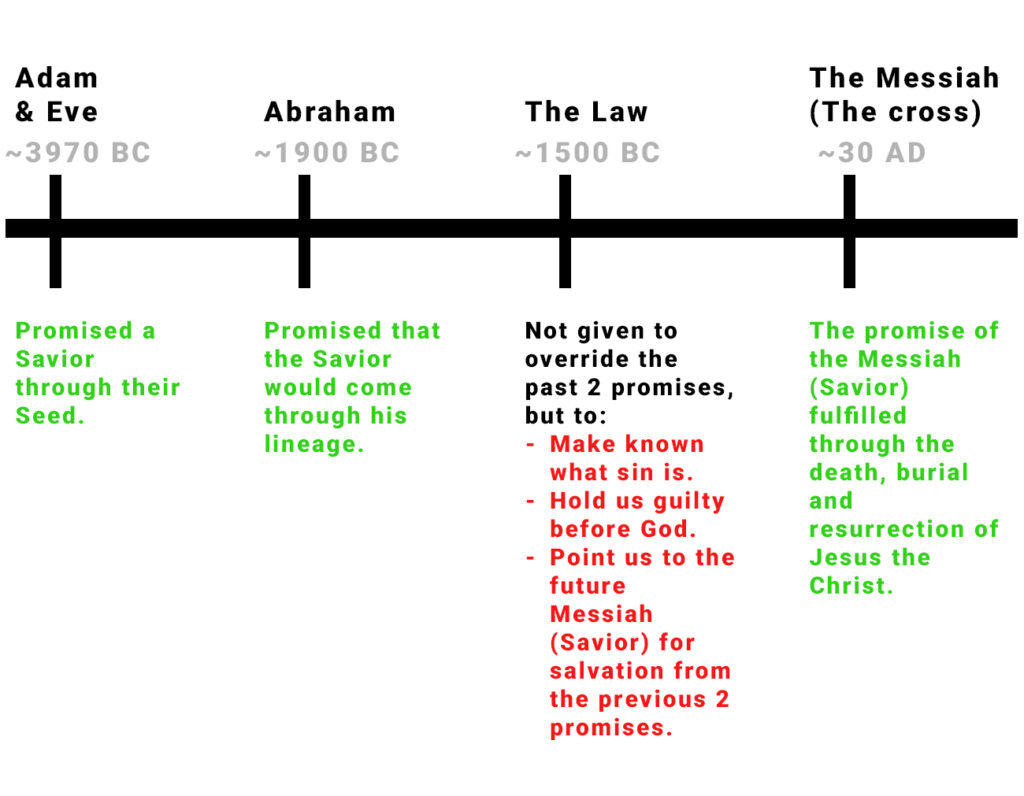
    Timeline of events:

    1. First, God promised to Adam and Eve that a Messiah (their Savior) would come through their Seed. (Genesis 3:15)
    2. Second, God promised again to Abraham that all the nations would be saved through faith in the Seed (Christ) that was to come through his lineage. (Galatians 3:5-9)
    3. 430 years later, God gave the law. It doesn’t override the original two promises of salvation by faith in the Messiah (Savior). (Galatians 3:15-18)
    4. Around 1500 years after the law was given, the Messiah, Jesus Christ, fulfilled God’s original promise of sending a Messiah through the lineage of Abraham, that all who believe in His death, burial and resurrection would be saved.

    God didn’t give the law 430 years after His promise of salvation by faith and say, “Ok, scratch that. I change My mind. Salvation is no longer by faith in the Messiah (Christ) that is to come through Abraham’s lineage, but is now through following the law perfectly.” Salvation was originally and always has been by faith, and the law was implemented later for the three reasons mentioned first in this note. (Galatians 3:15-18)

    Truthfully, man has always known that God would provide a Savior for man for their sin, all the way back to Adam and Eve (Genesis 3:15). Before the Messiah came, faith in God and His plan of redemption through a Messiah is what saved before the resurrection. After Christ’s resurrection, faith in Jesus Christ (the now known Messiah) saves now.

    God, who cannot lie, originally promised Adam and Eve that they would be saved through their offspring, and was again promised to Abraham that through his lineage the Messiah would come, and all who place their faith in Him would be saved. The law was only given to: (1) Show us what is right and wrong morally (2) Hold us all accountable (make us guilty) before God (3) Point us to faith in Christ for salvation.