Author: Adam

  • Why We Love Jesus

    Life is all about feeling pure peace and joy, which makes us feel good (for the kingdom of heaven is about peace, joy and righteousness — Romans 14:7). And Jesus, His power, vastness, beauty, intelligence, design skills and creativity, and His ways of character and conduct leaves us in awe and brings us peace and joy, making us feel good and impressed. Versus the world’s ways that bring us misery, and for that we don’t love the world, because it makes us feel bad.

    1. He loved us first.
    2. He died for us so that we could have eternal life with Him forever. See note: The Gospel
    3. His character and personality. He’s: loving, peaceful, joyful, kind, gentle, patient, self-controlled, faithful, good, not envious, humble, not rude, not self seeking, does not anger, thinks no evil and does not rejoice in it, rejoices in good, bears with us.
    4. His ways are nothing but pure peace, joy, love and righteousness. See note: The Ways of God vs The Ways of the World
    5. His attributes: all powerful, intelligence, wisdom, creativity, beauty.
    6. What He gives us: a new glorified sinless body, a mansion designed just with us in mind, the finest white robes of righteousness, and much more that we cannot even fathom right now.
    7. He always takes care of and provides for us materially.
  • Humility and Exaltation

    Exalt — hold someone in very high regard; to think or speak very highly of.

    A humble and loving servant of all is the one who is highly exalted according to the truth (of the ways of God) – in God’s kingdom. The lie of the world is that those who are beautiful, popular, powerful, wealthy and possess many things are highly exalted. But God’s ways are the real way, and the world’s ways are just a lie.

    Humble — not thinking you’re better than others for the beauty, knowledge, career success, wealth and things you possess – not making your boast in them. Not showing partiality, knowing we’re all equal. And not thinking you’re better than others for serving others. Having a lowly opinion of yourself (not a bad or negative opinion, just knowing you’re not better than others) in the way the world views people for their material and vanity. Knowing I’m not self-sufficient (I’ve accomplished nothing on my own)…being completely dependent on God for everything: salvation, health, safety, income, career success, help growing in godliness with the power of the Spirit, ministry, the timing of everything, and not relying on any of these things, knowing they can all be taken in an instant. Nothing makes you “better” than the next person. We’re just “highly regarded” and “highly spoken of”.

    Knowledge — to have knowledge simply means that you’re further along in your walk – not better than others. Use that knowledge to benefit others by teaching them in order to get them quickly up to speed where you are in your walk.

    Wealth — serve with love and use that wealth to benefit the needy.

    Prejudice — having a preconceived opinion of a person’s inward man based on the appearance of their outward man. Do you think a person’s inward man is better or worse based on how they dress? Do you think a person’s inward man is better or worse based on the car they drive?

    If God gives you a ton of wealth, the key is to remain humble, knowing you’re not better than anyone else for the wealth that’s been given to you. To remain content with simple necessities to get you through this life and not pursue excess luxuries: castles and planes and yachts and multiple mansions and dozens of fancy cars – all excessive things that one doesn’t need. Rather, lovingly serve others with the vast majority of the wealth that’s been given to you by distributing to the needy. That money is God’s money entrusted to you to distribute to the needy to get them through this temporary life.

    Exaltation according to the lie of the ways of the world: fame, fortune, power and beauty.

    Exaltation according to the truth of the ways of God in His kingdom: humility, love for God, love for strangers, servanthood.

    This life is but a blip compared to eternity. Our mission in this life is to get in, get saved, grow in godliness, get others saved, help others in need, and get out to the eternal state in heaven.

    We brought nothing into this world, and the key is that we will carry nothing out except our humility, our love for God and our love for our neighbor (or lack thereof). All we have – the only thing that lasts – is our humility, our love for God and our love for our neighbor.

    Your humility and love get you an exalted status.

    That extra wealth (and the intelligence/talent/opportunities used to acquire that wealth in this world) was given to you by God to bless the needy abundantly, not for storing up for yourself.

    It’s about the person – not the material. Are you a lowly, God fearing (you believe the gospel, you respect God’s ways, you follow God’s ways), loving person. The material means nothing. “I will exalt you if you are lowly, God fearing and loving.”

    “A man’s life does not consist in the abundance of his possessions.” It consists of his humility, love for God and love for strangers. Possessions don’t bring our inward man peace and joy. The fruits of the Spirit of humility, love, kindness, peacefulness, gentleness, goodness, patience, self-control, faithfulness and holiness do.

    Reducing it down: Heart posture is what exalts you (the state of your inner man) – not material.

    You need to be able to separate what the world exalts you for, vs what God exalts you for. Knowing the way the world exalts you (according to the lie that you’re better for these things), and knowing the way God exalts you (according to the truth of the ways of God):

    • The world exalts you for your career success, wealth, power, beauty, fame, quality of possessions, the way you dress and present yourself. This is the lie. This is not what’s reality.
    • God exalts you for your love for Him (accepting His way of salvation, and respecting and following His ways of godliness), your love for others, and your humble, lowly opinion of yourself – not thinking you’re better than anyone for anything (in context of how the world ranks people from least to greatest based on material possession and vanity). This is the truth. This is what’s reality.

    I don’t mind at all that you have a successful career, that you have wealth, that you’re beautiful, that a lot of people know you. But I know that you’re not better than anyone for those things. What I judge is if you have a humble, lowly opinion of yourself despite having those things, and if you love God (believing the gospel for salvation and walking in godliness) and if you love and serve others, especially strangers. And if you do, then I exalt you.

    See the person, not the material. See what type of person they are – not what they possess. See the rich – they need humility. See the God fearing, loving, humble and poor – glory in your exaltation, for God has highly exalted you. See the rich – are they humble despite their circumstances? Do they fear God, exhibit godliness, and love others and serve them? James 1:9-11 – let the humble glory in his exaltation. Let the rich glory in his humiliation.

    The world judges and exalts you based on material and vanity. God judges and exalts based on love and humility. The world exalts the possessions. God exalts the inner person.

    The world approves you based on your career, wealth, beauty, fame, the quality of your possessions, the way you dress and present yourself. God approves you based on the heart – the inner man. I seek to be approved by God – not the world.

    You can’t know a man by simply looking at him – by whether he’s wealthy looking or poor looking. Test the spirit against the truth of God, to see what kind of man he is, and whether to exalt them or not. The world says a wealthy looking man is better, and a poor looking man is scum. But God says a poor looking man that loves God, loves and serves others and is humble, is highly exalted over the wealthy looking man who is prideful and unloving towards God and others. Take the wealthy looking and the poor looking man out of their homes, then out of their cars, strip them naked and judge their inner man. The poor looking man might be the rotten one, whereas the wealthy looking man may be exalted in God’s eyes, or vice-versa.

    Stop judging like the world and judge like God:

    1. Strip them naked of all their possessions, fame and beauty.
    2. Test the spirit to see if they’re humble, God loving and fearing, and love and serve strangers (Luke 6:32-36 — But if you love those who love you, what credit is that to you? For even sinners love those who love them).
    3. Make a judgement: approve or disapprove concerning the ways of God.
    4. If approved: exalt.

    See what comes out of a man/woman. See what comes out of you as well.
  • Overcoming evil with good

    Romans 12:21 — “Be not overcome of evil, but overcome evil with good.”

    How do we overcome evil with good?

    First, what is good?

    Ephesians 5:9 — “(for the fruit of the Spirit is in all goodness, righteousness, and truth)”. So, the fruit of the Spirit is what’s “good”, “righteous”, and “truth” (the ways it really is).

    What is the fruit of the Spirit?

    Galatians 5:22-23 — “But the fruit of the Spirit is love, joy, peace, longsuffering, kindness, goodness, faithfulness, gentleness, self-control.” What is “love”? 1 Corinthians 13:4-7 — “Love suffers long and is kind; love does not envy; love does not boast, is not proud; does not behave rudely, does not self seeking, is not provoked to anger, thinks no evil; does not rejoice in iniquity (evil), but rejoices in the truth (the good ways of God); bears all things, believes all things, hopes all things, endures all things.”

    What is evil?

    Hatred, evil speaking, insults, criticisms, negativity, harshness, outbursts of anger, and the like.

    How to overcome that evil:

    When someone gives us evil (they insult and criticize us, hate us, get angry with us, etc.), we respond with the fruits of the Spirit: patience and longsuffering, self-control not to get angry in return, gentleness instead of being harsh in return, not returning evil for evil, and grace (undeserved kindness) – which ultimately leads to forgiveness.

    How many times should we forgive others?

    In Matthew 18:21-22, Peter asked Jesus if he should forgive his brother up to seven times, suggesting a generous limit based on the cultural standards of the time. Jesus responded that he should forgive not just seven times, but “seventy times seven” (or seventy-seven times), meaning that forgiveness should be limitless and not based on keeping count.

  • Getting rid of anger and bitterness

    The sole key to getting rid of anger and bitterness is: giving grace (undeserved kindness), mercy and forgiveness. That’s it. It’s that simple.

    How many times should we forgive others?

    In Matthew 18:21-22, Peter asked Jesus if he should forgive his brother up to seven times, suggesting a generous limit based on the cultural standards of the time. Jesus responded that he should forgive not just seven times, but “seventy times seven” (or seventy-seven times), meaning that forgiveness should be limitless and not based on keeping count.

  • Why we don’t argue to make a point

    “And a servant of the Lord must not quarrel (be argumentative) but be gentle to all, able to teach, patient” — 2 Timothy 2:24

    First, why do we argue? We do it thinking we’re going to make a point and get the opposing party to “see it our way”.

    But we all know that never works. Rather, arguing breeds all sorts of hostility, anger, resentment and bitterness, and does the opposite of what your end goal is – it persuades the other person to not listen rather than listen.

    Instead, we must be kind, patient and self-controlled with the opposing party, even if they’re hostile, gently teaching them your point.

    However, when trying to teach someone a point, if they remain hostile and just won’t listen to what you have to say and don’t want to learn, after the second attempt, move on — Titus 3:10.

  • Why does God test us?

    God first places us upon and builds us up on the foundation of Christ, which are all His ways/truths/teachings. Once we’re built up on that foundation, He tests us with lies to see if we’ll stand firm in the ways He’s taught us, and won’t succumb to and be persuaded by the lies.

    It helps us to:

    1. Grow more confident in His ways.
    2. Grow a stronger conscience, knowing what we do and say in Christ (in the ways of God) are the correct things.
    3. Gives us greater discernment to be able to detect and approve the things that are good (the ways of God) and to be able to detect and reject the lies.

    God even tested Jesus Himself by sending Him into the wilderness for 40 days to be tested by Satan with the lies of the lust of the flesh, the lust of the eyes and the pride of life before He could be approved for His ministry, to see if He was ready.

  • Worldly vs Godly Success

    God won’t allow me to have worldly success, that is, what success looks like in the eyes of the world: wealth, fame, power, pride, ego, beauty, women, a loud and busy life.

    Instead, God wants me to be successful according to His ways: to lead a lowly, quiet and peaceful life with all humility and meekness. A life of walking in the Spirit and exhibiting the fruits of the Spirit: love, joy, peace, kindness, gentleness, patience, self control, humility, forgiveness, not angry, not rude, goodness and faithfulness. A life of keeping my mind focused on the things of God throughout all my days (how I’m saved, my identity as a child of God, my spiritual blessings and gifts, walking in the Spirit, the ages to come), rather than the things of the world (money, possessions, politics, status, relationships). Being content with and thankful for all that Father has given me in this life – not so much that I become conceited and plugged into the world (losing focus on the Godly way of life [the fruits of the Spirit] vs the worldly way of life [popularity, wealth, power, beauty, possessions – the lust of the flesh, the lust of the eyes and the pride of life]), and not too little as to struggle – knowing that what’s laid up for me in heaven far outweighs and exceeds that of which the world can offer me:

    • Eternal life
    • A new immortal, sinless and glorified body that:
      • Never gets sick
      • Never feels pain
      • Never ages or dies
      • Never has to relieve itself
      • Never gets tired
      • Never sins
    • A most beautiful, glorified heavenly country where the rule of the land is only true righteousness, joy, peace and love.
    • Eternal rest from the curse of hard work.
    • A city (New Jerusalem) whose foundations are built by God Himself.
    • A mansion within New Jerusalem designed, architected and built just for me by Christ Himself.
    • A place where I’m with all my friends and family in a truly righteous environment for all eternity.
    • A place where I get to be with all my pets, in which we can even speak the same language, for all eternity.
    • A place where I can be with my guardian angel for all eternity.
    • And last, but definitely first, a place where I can hang out and be with my Father and my Abba Jesus face to face, for all eternity.
  • Don’t Doubt Your Salvation

    Do you ever have times of doubt about your salvation? This is normal, as the enemy is relentless. Know how the Holy Spirit vs the enemy and the flesh works:

    First, reassure yourself of your belief in the simple gospel truth. Take all emotion and feelings out of it and think upon these salvation scriptures with pure logic:

    IF: you believe the gospel found in 1 Corinthians 15:1-4 (that Christ died to pay for all our sins, was buried and rose again the third day) and don’t trust in any of your own works (Ephesians 2:8-9)

    THEN: the nanosecond you first believed that gospel you were indwelt by and sealed with the Holy Spirit, which is the guarantee of your eternal life and salvation (your inheritance) — Ephesians 1:13-14.

    Now, understand how the Holy Spirit and the enemy work to convict believers (the saved) and unbelievers (the unsaved):

    For unbelievers:

    God wants all people saved, and uses the Holy Spirit to convict unbelievers of their sin and their need for the Savior Jesus. The enemy wants to drag people to hell with them, and deceives the unbeliever into thinking that they are either “a good person” or are in “the proper religion (other than pure gospel faith Christianity)” or have “turned from all their sins” and are going to heaven for it, or straight up tries to deceive them into thinking that there is no God or afterlife at all, so that they’ll never seek the truth of how to become saved.

    For believers:

    God wants them to have assurance of their salvation and convicts them of their righteousness (being perfectly acceptable to God) through faith in the gospel. The enemy hates the believer and knows they can’t have their soul anymore, so they try their hardest to steal the joy of your salvation by deceiving you into thinking that you are unsaved, perhaps telling you that you’ve committed too many bad sins lately or that you don’t truly believe the gospel. They can also sometimes try to bring you under works for salvation and tell you that you’re not turning from all your sins in order to be acceptable to God, and that you’ve lost your salvation (which is impossible. See note on: Eternal Security). Your flesh and the enemy can also custom tailor deceptions created just for your specific situation, so be aware of their schemings.

    Also understand that we as our reborn, renewed inner man is sinless (born of incorruptible seed and kept from sinning), yet we still live in our unregenerate sinful flesh (the outward man), and “the flesh (circumcised from the heart – our inner man) is deceitful above all else.” So your flesh can deceive you, and the enemy loves to stir up the flesh. See this note for more details on: The Inner Man vs the Outward Man

    The enemy can oftentimes easily overpower the still, small voice of the Holy Spirit, so if you’re saved by faith alone in the gospel (no works added) and you’re feeling condemned, it’s the enemy 100%. Just reboot:

    1. Take all feelings and emotions out of it.
    2. Logically progress over the gospel and the indwelling and guarantee of the Holy Spirit which you have believed in.
    3. Remember how the enemy works to deceive you and understand how they’re attacking you at that moment.
    4. Relax and find peace and comfort and joy in your salvation.
  • The Rich Young Ruler

    The story of the rich young ruler that asked Jesus what he must do to have eternal life is found in Matthew 19:16-21 and Mark 10:17-27.

    The rich young ruler came to Jesus asking what he needed to do to get eternal life. He assumed that it was by keeping the law perfectly, and he thought he had kept the law perfectly. But Jesus knew his heart and sought to teach him that he hasn’t been following the law perfectly and that by the young man’s standard he wasn’t saved. So Jesus told him all the things to do in the law which he thought he was doing, except for one thing that Jesus brought up that he wasn’t doing, showing the young man that he hadn’t been keeping the law perfectly. This was to get the young man to say to himself, “Uh oh. How can I be saved then if I’ve failed at keeping the law?” And then Jesus told him to do the right thing by using his rich abundance to supply the lack of others by selling his stuff and giving to the poor (not for salvation, but because he wouldn’t need those worthless possessions anymore and the poor always need help and that’s the right thing to do), and then to follow Him so that he could learn that salvation is through believing in Him and not by following the law.

    Mark 10:17-27:
    As He (Jesus) was setting out on a journey, a man (the rich young ruler) ran up to Him and knelt before Him, and asked Him, “Good Teacher, what shall I do so that I may inherit eternal life?” But Jesus said to him, “Why do you call Me good? No one is good except God alone (Yes, Jesus is good as He is God, but what He’s doing is setting up to show the man who wants to be justified by the law that only God is good and not humans per the law’s standard). You know the commandments: ‘Do not murder, Do not commit adultery, Do not steal, Do not give false testimony, Do not defraud, Honor your father and mother.’” And he said to Him, “Teacher, I have kept all these things from my youth.” Looking at him, Jesus showed love to him and said to him, “One thing you lack (here Jesus shows the young man that he failed to keep the law perfectly): go and sell all you possess and give to the poor (because it’s the right thing to do by using his rich abundance to supply the lack of others by selling his stuff and giving to the poor [not for salvation, but because he wouldn’t need those worthless possessions anymore and the poor always need help and that’s the right thing to do]), and you will have treasure in heaven; and come, follow Me (to learn that eternal life is gained by believing in Him rather than by following the law).” But he was deeply dismayed by these words, and he went away grieving; for he was one who owned much property. And Jesus, looking around, said to His disciples, “How hard it will be for those who are wealthy to enter the kingdom of God!” (Because most people trust in their works: “being a good person” rather than by faith in Christ alone) And the disciples were amazed at His words. But Jesus responded again and said to them, “Children, how hard it is to enter the kingdom of God! It is easier for a camel to go through the eye of a needle than for a rich person to enter the kingdom of God.” And they were even more astonished, and said to Him, “Then who can be saved?” Looking at them, Jesus said, “(Jesus coming full circle here:) With people it is impossible (following the law), but not with God; for all things are possible with God (His salvation through faith in the gospel).”

  • Christ’s Love in Perspective

    The Bible tells us that Jesus loved us so much that He gave His life to save us, and that there is no greater love than to lay down your life for another. Let’s put that love into perspective:

    Imagine you were a saved believer in Christ, and that your favorite parent/sibling/spouse/child/friend (choose one) was an unbeliever. Now imagine that God told you, “I’ll get that person saved by getting them to realize how fragile life is and that their next breath isn’t promised, but in order for them to realize that, you yourself must be put into a most brutal and painful car accident that will nearly take your life.” Would you willingly jump at the opportunity? Deeply, deeply consider and meditate on this. (If I’m being honest, I had to think many more times than “twice” about this, and still haven’t made a decision, questioning if there could possibly be an easier way)

    Next, imagine that it wasn’t your favorite person in the world that you are going to go through that for, but rather it is for someone that has been the most awful to you.

    Jesus gladly jumped at the opportunity to die a most painful death to save us horrible, rotten, sinful humans who for the most part have despised, made fun of and rejected Him. Why? Because that’s how much He loves us. Yet even He, the night before His death, asked the Father if our salvation could be secured a different and easier way. And when He was told “No”, He went to the cross anyway.

  • Why You Won’t Find James 2 on This Website

    God loves to test the genuineness of our faith. In the very second and third verses of James 1 it says: “My brethren, count it all joy when you fall into various trials, knowing that the testing of your faith produces patience.”

    And in 1 Peter 1:6-7 it says: “In this you greatly rejoice, though now for a little while, if need be, you have been grieved by various trials, that the genuineness of your faith, being much more precious than gold that perishes, though it is tested by fire, may be found to praise, honor, and glory at the revelation of Jesus Christ

    James has a lot of good nuggets of godly knowledge and wisdom that he’s learned from Christ that are found throughout his book, but at the end of the day, the book of James (especially James 2) is as good as the rest of the apocrypha – uninspired by God, and cannot be because it plainly contradicts the entirety of the rest of scripture.

    Hundreds of years ago when those who were discussing what books should be in the Bible, the book of James was a heavily debated book. And the Lord told me that the reason He allowed Satan to sneak it in there was for it to be a test of faith for us (as I said earlier in this note, He loves to test the genuineness of our faith). If you can take the entirety of scripture (100’s of verses) that says that salvation is by faith in Christ alone, no works, and negate all of that for 2 simple James 2 verses that plainly say that salvation is by works, then you have failed the test of faith and are not worthy of God. The Lord tests our faith with James 2: are you going to keep your pride and say that Christ’s sacrifice wasn’t enough and that you need to have works to prove your salvation, or are you going to humble yourself completely and say, “Man, I know James 2 says my faith without works is dead, even though the rest of scripture says it’s not by works, but I’m deciding to throw out James 2 and go all in on Christ and put all my eggs in His basket and not trust in any of my own works.” Proverbs 16:18 — Pride goes before destruction, And a haughty spirit before a fall.

    I’ve heard every way under the sun from people trying to reconcile James 2 to the rest of scripture and what it “really means”, twisting it to try and make sense of it, but James makes it very clear what he means in verses 24-25: “You see then that a man is justified by works, and not by faith only. Likewise, was not Rahab the harlot also justified by works when she received the messengers and sent them out another way?” He says we’re justified by works. Plain and simple.

    But we know that the entirety of the rest of scripture attests to salvation being by faith alone, and not by works: Ephesians 2:8-9 — “For it is by grace you have been saved through faith, and this not from yourselves; it is the gift of God, not by works, so that no one can boast.” Also consider the parable Jesus Himself told concerning the Pharisee (religious leader) and the tax collector, where the Pharisee supposed that he was acceptable before God for his works, vs the sinful tax collector who realized he was a sinner simply in need of mercy:
    Luke 18:9-14 — Also He (Jesus) spoke this parable to some who trusted in themselves that they were righteous, and despised others: “Two men went up to the temple to pray, one a Pharisee and the other a tax collector. The Pharisee stood and prayed thus with himself, ‘God, I thank You that I am not like other men—extortioners, unjust, adulterers, or even as this tax collector. I fast twice a week; I give tithes of all that I possess.’ And the tax collector, standing afar off, would not so much as raise his eyes to heaven, but beat his breast, saying, ‘God, be merciful to me a sinner!’ I tell you, this man went down to his house justified rather than the other; for everyone who exalts himself will be humbled, and he who humbles himself will be exalted.”

    See faith alone scriptures in the note: The Knowledge and Wisdom of God

  • Freed From the Law and Sin (Romans, chapters 3-8)

    This note explains the somewhat confusing and complicated chapters of Romans 3-8.

    The first thing to understand is the dichotomy of the inner man vs the outward man. A brief overview: we are actually a soul, that has a spirit, and lives inside our fleshly body. For more details, see the note: The Inner Man vs the Outward Man (opens in a new window)

    The next thing to understand is that “sin” is not just some abstract concept or idea. It’s a literal living thing that lives in our fleshly bodies:

    • Sin “entered” the world when Adam ate of the forbidden fruit. (Romans 5:12)
    • Sin “lives” in our fleshly bodies. (Romans 7:17-18; Romans 7:20; Romans 7:21-23)

    What is a law?
    When you’re under a law, you must obey it. If the law says, “You shall not steal”, then you cannot steal. And with laws, there’s consequences for going against it. For the law (the 10 commandments), it’s condemnation and death with eternal hellfire.

    What is a master-slave relationship?
    Likewise, if we were under bondage as a slave to a master, the slave must obey their master. If the master says, “Steal”, then you must steal.

    What is the rule about being under laws?
    The rule that God instantiated about laws is that when you die, you are released from the law you were under.

    The same goes for master-slave relationships. When you die, you are no longer the slave of the master you were owned by.

    We are all born under the law, and sin quickly becomes our master. As slaves of our master (sin) we obey its commands to break the law. And when we break the law, we are condemned to death and eternal hellfire as just punishment.

    So the question is: “If we get freed from laws and masters by death, how do we get freed from the law (the commandments) and our master (sin)?” The answer: we must die, and then we will be released from our master (sin), and from the law that condemns us. Here’s how we “die”:

    For this next part, you must understand the gospel: 1 Corinthians 15:1-4 — that Christ (1) died to pay for all our sins (2) was buried and (3) rose again the third day.

    The next logical question is: “How do we die?” The answer: when we believe the gospel, we are spiritually crucified with Christ. It is like our body/flesh was literally put to death on the cross (the gospel: step 1). So there, we just died (and the sin within us along with us). The moment we believed the gospel, our flesh died and we were released from our former master (sin), and from the law that condemned us when we sinned. Our dead outward bodies and the sin within were then buried (the gospel: step 2), and we as our inner man was spiritually reborn of incorruptible Seed and raised back to life (the final gospel step 3), and now our new selves are now slaves to God and are under His law of grace. All this is what’s meant by being baptized (following Christ) into Christ’s death, burial and resurrection.

    So, Christ redeemed us (freed us) from our master (sin), as well as the law that condemned us when we sinned, when we believed in His death on the cross (for the payment for our sins), His burial and His resurrection. And that believing He did that for us, we are then baptized (following Him) into His death, being set free from sin and the law, and are raised to new life under our new master (God) and His law of grace.

    We are now a slave of our new Master, God, who redeemed (freed) us from our old master, sin. What does God command us to do? He commands us to believe the gospel for salvation, and to “be holy”: “Be holy, for I am holy”. (If I’m saved by faith, why be holy? See note on: The Ways of God vs the Ways of the World [The best note on this site. Opens in a new window])

    And not only are we God’s slave now, we are now also under the law of grace, being set free (redeemed) from the former law that condemned us. What does the law of grace say? It says: “If you do sin and break the other law, you are forgiven instead of condemned.”

    And just because we’re now under the law of grace (forgiveness) instead of the law of condemnation, it doesn’t mean that we should use that as an excuse to let our flesh sin and break the old law. We absolutely could, but we are told not to. Instead of totally disregarding the old law, we uphold it because we agree that its statutes are good (it’s good not to steal, it’s good not to murder, it’s good not to lie, etc.). We’re just not condemned by it when our flesh does break it, because we’re no longer under it, as we’re now under the law of grace.

    Now, there’s the spiritual reality of our flesh being dead, but then there’s also the physical reality: that our flesh is not dead yet and is very much alive and sin still lives in it. But we’re to reckon/consider/pretend our flesh to be dead, which means that we are free from our former master (sin), and since we’re no longer sin’s slave, we no longer obey it when it tells us to sin. We are to act/behave as if our sinful flesh is actually dead and deprive our flesh of its desire to sin. Instead, we obey our new Master (God), who commands us to be holy. And when our flesh overtakes us and we fail to be holy in the flesh, remember, we are no longer under the old law that condemned us for it, we are now under the law of grace that forgives us.

    Does “being dead to sin” mean that we won’t sin anymore? No. Remember, spiritually we’re dead to sin, but the physical reality is that our sinful flesh is still alive and desires to sin. We’re simply to pretend it’s dead and deprive it of its desire to sin to the best of our ability. See this note on how to do this: The Ways of God vs the Ways of the World (The best note on this site. Opens in a new window)

    Even Jesus (God) took on human nature and had a fleshly body with sin in it. But since He was also God within that flesh, He was able to deprive that sin of its desires, thus fulfilling the law (something us humans couldn’t do). (Romans 8:3)

    On the cross, God the Father put all our sin in Christ’s fleshly body. Jesus bore our sin in His flesh on the cross, and God put His body/flesh to death, along with all our sins in it: 1 Peter 2:24 — “who Himself bore our sins in His own body on the tree (the cross), that we, having died to sins, might live for righteousness—by whose stripes (wounds) you were healed.”

  • Why the Law Was Given

    The law (the 10 commandments) was not given to save people by following it. It was given to:

    1. Show us what is right and wrong morally.
      1. Paul says in Romans 7:7 that he would not have known what coveting was unless there was a law that said, “You shall not covet.”
      2. Galatians 3:19.
    2. Hold us all accountable (make us guilty) before God.
      1. Galatians 3:22.
      2. Romans 3:19.
      3. As a just and fair God, He has to have something to judge us by if we don’t place our faith in Christ for salvation. And if we don’t believe in Christ for salvation, then He will justly judge our actions by the law, and we will receive fair punishment in hell for all eternity.
    3. Point us to Christ for salvation.
      1. Galatians 3:24-25.
      2. The law says, “Man, you’re guilty of breaking me and are condemned. You better believe in Christ to get those sins forgiven, or else you’re going to hell.”

    On a side note: If the law were to be the means to be saved, it would have to be followed perfectly, never once broken in your entire life. (Galatians 3:10)

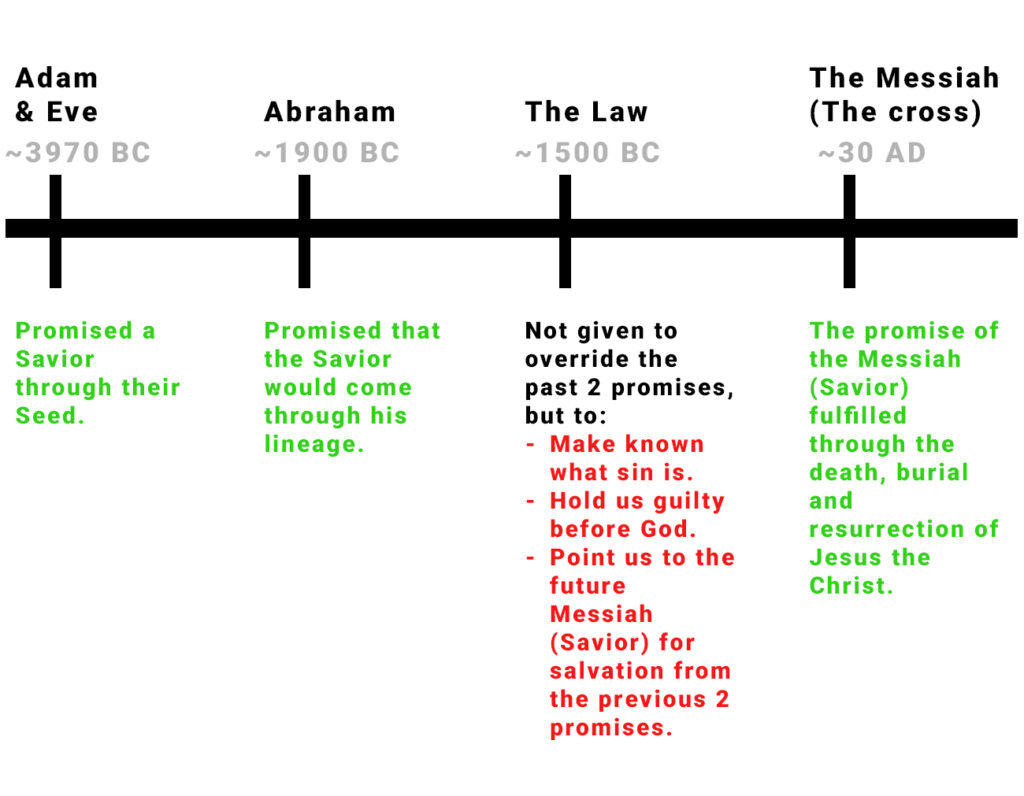
    Timeline of events:

    1. First, God promised to Adam and Eve that a Messiah (their Savior) would come through their Seed. (Genesis 3:15)
    2. Second, God promised again to Abraham that all the nations would be saved through faith in the Seed (Christ) that was to come through his lineage. (Galatians 3:5-9)
    3. 430 years later, God gave the law. It doesn’t override the original two promises of salvation by faith in the Messiah (Savior). (Galatians 3:15-18)
    4. Around 1500 years after the law was given, the Messiah, Jesus Christ, fulfilled God’s original promise of sending a Messiah through the lineage of Abraham, that all who believe in His death, burial and resurrection would be saved.

    God didn’t give the law 430 years after His promise of salvation by faith and say, “Ok, scratch that. I change My mind. Salvation is no longer by faith in the Messiah (Christ) that is to come through Abraham’s lineage, but is now through following the law perfectly.” Salvation was originally and always has been by faith, and the law was implemented later for the three reasons mentioned first in this note. (Galatians 3:15-18)

    Truthfully, man has always known that God would provide a Savior for man for their sin, all the way back to Adam and Eve (Genesis 3:15). Before the Messiah came, faith in God and His plan of redemption through a Messiah is what saved before the resurrection. After Christ’s resurrection, faith in Jesus Christ (the now known Messiah) saves now.

    God, who cannot lie, originally promised Adam and Eve that they would be saved through their offspring, and was again promised to Abraham that through his lineage the Messiah would come, and all who place their faith in Him would be saved. The law was only given to: (1) Show us what is right and wrong morally (2) Hold us all accountable (make us guilty) before God (3) Point us to faith in Christ for salvation.

  • Preventative Measures

    Want to prevent illness and evil from happening to you? Psalm 91 has your answer. It basically boils down to: “If you believe that Christ will keep you from all evil and illness, then He will.” He is able, and He is willing. You don’t have to know how it works, just know that it does.

    Psalm 91:

    1 He who dwells in the secret place of the Most High
    Shall abide under the shadow of the Almighty.
    I will say of the Lord, “He is my refuge and my fortress;
    My God, in Him I will trust.”

    Surely He shall deliver you from the snare of the fowler
    And from the perilous pestilence.
    He shall cover you with His feathers,
    And under His wings you shall take refuge;
    His truth shall be your shield and buckler.
    You shall not be afraid of the terror by night,
    Nor of the arrow that flies by day,
    Nor of the pestilence that walks in darkness,
    Nor of the destruction that lays waste at noonday.

    A thousand may fall at your side,
    And ten thousand at your right hand;
    But it shall not come near you.
    Only with your eyes shall you look,
    And see the reward of the wicked.

    Because you have made the Lord, who is my refuge,
    Even the Most High, your dwelling place,
    10 No evil shall befall you,
    Nor shall any plague come near your dwelling;
    11 For He shall give His angels charge over you,
    To keep you in all your ways.
    12 In their hands they shall bear you up,
    Lest you dash your foot against a stone.
    13 You shall tread upon the lion and the cobra,
    The young lion and the serpent you shall trample underfoot.

    14 “Because he has set his love upon Me, therefore I will deliver him;
    I will set him on high, because he has known My name.
    15 He shall call upon Me, and I will answer him;
    I will be with him in trouble;
    I will deliver him and honor him.
    16 With long life I will satisfy him,
    And show him My salvation.”

  • Sins: Paid, Forgiven, Removed, Forgotten

    All of our sins were paid for on the cross 2000 years ago, and the nanosecond you believed the gospel, your sins were:

    1. Forgiven
      Ephesians 1:7 — In Him we have redemption through His blood, the forgiveness of sins, according to the riches of His grace
    2. Removed
      Psalm 103:12 — As far as the east is from the west, So far has He removed our transgressions from us.
    3. Forgotten
      Hebrews 8:12 — For I will be merciful to their unrighteousness, and their sins and their lawless deeds I will remember no more.
  • Sports

    Life is purely about feeling peace and joy. Sports can be great for teamwork, but at the end of the day, sports pretty much only brings about:

    1. Pride.
    2. Envy and jealousy.
    3. Greed.
    4. Lust.
    5. Depression.
    6. Mental and physical pain.
    7. Evil speaking from others.

    All things making life not worth living.

    Life is purely about feeling peace and joy. Sports only brings about two kinds of fleeting feelings of joy:

    1. The worldly joy of the feeling of winning: This joy is worldly, and not of God, in the sense of, “I won because I’m better than you.” For what other joy is there in winning besides feeling better than someone else? – meditate deeply on this. When we know that the truth according to God is that we’re not better than anyone for any reason. We’re merely “exalted” based on our humility (do we keep a lowly option of ourselves [not better than anyone] despite our worldly successes?), our love for God and walking in His ways, and our love for strangers and serving them. The world ranks people as better or worse than the next based on physical sports talent. God values the heart – the inner man – their humility, love for God, and love for strangers.

    The joy of witnessing what God created the human body & mind to be able to do: throwing a perfect ball. An amazing catch. This type of joy is independent of loyalty to any specific player or team, and simply enjoys watching the physical and mental talent of any human’s capabilities the way God designed us and programmed us. This type of joy doesn’t lift up and glorify the person for their talents, it all traces back to God and glorifies Him for his wisdom and intelligence for how He designed the human body.

  • The Savior brings The Good News

    Not good news:
    Behold! I am the messiah! I bring you good news on how to get to Heaven: keep the whole law perfectly and never once stumble! Good luck!

    Good news:
    Behold! I am the messiah and have come to pay for all of your sins so that you can get into heaven! Just believe in Me! That’s it!

  • Faith is Power

    It’s all about faith. NOT works. It’s impossible to please God without faith. That’s what He desires and cares about – faith in the unseen. Faith in the impossible – “for all things are possible with God.” We live in a physical, visible world with hard limits and tough work. The kingdom of God is invisible, limitless, of power and ease – with God’s ability to speak things into existence. Faith is power. God wants faith! Not works! It’s the power to get things done. It’s the power to save. But you MUST not doubt, or you should not expect to receive.

    Biblical definition of faith
    Hebrews 11:1 — Now faith is confidence in what we hope for and assurance about what we do not see.

    The kingdom of God is power
    1 Corinthians 4:20 — For the kingdom of God is not a matter of talk but of power.

    Blessed are those who trust in God
    Jeremiah 17:7 — “But blessed is the one who trusts in the LORD, whose confidence is in him.

    Know that anything is possible with God
    Matthew 19:26 — Jesus looked at them and said, “With man this is impossible, but with God all things are possible.”
    Jeremiah 32:27 — “I am the LORD, the God of all mankind. Is anything too hard for me?
    Jeremiah 32:17 — “Ah, Sovereign LORD, you have made the heavens and the earth by your great power and outstretched arm. Nothing is too hard for you.

    Without faith in God, nothing can happen
    Hebrews 11:6 — And without faith it is impossible to please God, because anyone who comes to him must believe that he exists and that he rewards those who earnestly seek him.

    God’s power has the ability to do anything outside of human limits. Don’t let the “wisdom of humanity” that says certain things can’t be done fool you into thinking something’s not possible, when it is indeed possible with God through unwavering, childlike faith
    1 Corinthians 2:5 — so that your faith might not rest on human wisdom, but on God’s power.

    You must believe and trust in God with all your heart
    Proverbs 3:5 — Trust in the LORD with all your heart and lean not on your own understanding;

    Faith in the gospel is the arm of God’s power to save
    Romans 1:16 — For I am not ashamed of the gospel, because it is the power of God that brings salvation to everyone who believes: first to the Jew, then to the Gentile.

    Believe with all your heart and do not doubt, and it will be given to you
    Mark 11:22-24 — “Have faith in God,” Jesus answered. “Truly I tell you, if anyone says to this mountain, ‘Go, throw yourself into the sea,’ and does not doubt in their heart but believes that what they say will happen, it will be done for them. Therefore I tell you, whatever you ask for in prayer, believe that you have received it, and it will be yours.

    God works miracles among you by your faith, not by your deeds
    Galatians 3:5 — So again I ask, does God give you his Spirit and work miracles among you by the works of the law, or by your believing what you heard [the gospel]?

    Even the smallest amount of faith is extremely powerful. Imagine what a lot of faith can do!
    Matthew 17:20 — He replied, “Because you have so little faith. Truly I tell you, if you have faith as small as a mustard seed, you can say to this mountain, ‘Move from here to there,’ and it will move. Nothing will be impossible for you.”

    Peter walked for a moment on water because of his faith, and when he began to doubt his faith, he began to sink.
    Matthew 14:22-31, especially verses 28-31

    You must not doubt your faith. Have childlike faith!
    James 1:6-7 — But when you ask, you must believe and not doubt, because the one who doubts is like a wave of the sea, blown and tossed by the wind. That person should not expect to receive anything from the Lord.

    God does not perform many miracles where there is no faith
    Matthew 13:58 — And he [Jesus] did not do many miracles there because of their lack of faith.

    And of course, what you ask for in faith must be reasonable and of the things of God. Example: you can’t have faith in winning the lottery and expect to win.
    James 4:3 — When you ask, you do not receive, because you ask with wrong motives, that you may spend what you get on your pleasures.

    Live reasonably and don’t put God to the test with your faith. Example: don’t ask God to keep you from getting the flu and then go out of your way to lick a petri dish full of the flu virus.
    Luke 4:9-12 — The devil led him to Jerusalem and had him stand on the highest point of the temple. “If you are the Son of God,” he said, “throw yourself down from here. For it is written: “ ‘He will command his angels concerning you to guard you carefully; they will lift you up in their hands, so that you will not strike your foot against a stone.’” Jesus answered, “It is said: ‘Do not put the Lord your God to the test.’”

    Your faith will NOT be put to shame by those saying, “Uh huh! Where’s your God now?!?”
    Romans 10:11 — As Scripture says, “Anyone who believes in him will never be put to shame.”

    Faith in Action – just a few of MANY examples of the power of God’s healing by faith:

    1. A man that had faith that Jesus could heal, not even needing Him to be present, but just by saying the word
      Matthew 8:5-13, especially verses:

      7-8: Jesus said to him, “Shall I come and heal him?” The centurion replied, “Lord, I do not deserve to have you come under my roof. But just say the word, and my servant will be healed.

      10: When Jesus heard this, he was amazed and said to those following him, “Truly I tell you, I have not found anyone in Israel with such great faith.
      
13: Then Jesus said to the centurion, “Go! Let it be done just as you believed it would.” And his servant was healed at that moment.
    2. A woman that had faith that Jesus could heal, not even needing Him to speak, but just by her touching Him
      Mark 5:24-34, especially verses:
      
27-29: When she heard about Jesus, she came up behind him in the crowd and touched his cloak, because she thought, “If I just touch his clothes, I will be healed.” Immediately her bleeding stopped and she felt in her body that she was freed from her suffering.

      34: He said to her, “Daughter, your faith has healed you. Go in peace and be freed from your suffering.”
    3. Men that had faith that Jesus could heal, not even needing to touch Him, but just by being in His shadow!
      Acts 5:15 — As a result, people brought the sick into the streets and laid them on beds and mats so that at least Peter’s [an apostle of Christ with Christ’s authority to heal] shadow might fall on some of them as he passed by.

    Blessed are those who have not seen, yet still believe.
    John 20:29 — Then Jesus told him, “Because you have seen me, you have believed; blessed are those who have not seen and yet have believed.”

    God wrote His ENTIRE Old Testament and New Testament Bible around faith – faith in Him – and the abundant promises and blessings of having such faith. Upon acquiring such childlike faith, do you really think He’s then going to go back on all His promises and let you down and shame you because of the faith He demands, and then point your hope to that of the world and of men?

    The enemy whispers in your ear day and night and tells you that having faith and believing that something of God’s will – and believing it will indeed come to pass – is pride. He also gets you to doubt your faith by whispering in your ear, “Oh no, that’s just not possible. Don’t believe it because if you do, it won’t come true and you’ll just be let down and feel foolish.” Those are huge lies from Satan. Satan wants you to place your faith in what’s seen – the world and men – and to take your eyes off God and His truth.

    God says, you now have faith that I can do what you ask, but do you have faith that I will do what you ask?

  • Grace. Mercy. Justice.

    Grace = getting [good things] what we don’t deserve.

    Mercy = not getting what we do deserve [punishment].

    Justice = getting what we do deserve.

    Ephesians 2:8-9 — For it is by grace you have been saved, through faith—and this is not from yourselves, it is the gift of God— not by works, so that no one can boast.

  • The Stock Market of Salvation

    Stocks:

    • Christ alone – $777/share.
    • Christ + works – $0.01/share.
    • Judaism – $0.01/share.
    • Buddha – $0.01/share.
    • Allah – $0.01/share.
    • Atheism – $0.01/share.
    • The Mark of the Beast – $0.01/share.
    • All of the Above – $0.01/share.
    • Other – $0.01/share.

    Rules:

    • You get $777 to spend.
    • You can’t hedge your bets. You can only put all of your money into one stock. You have to, “put all your eggs in one basket.”
    • Only one stock will produce dividends. The rest will tank and you will lose your shirt.

    Stock Tips:

    • John 14:6 — Jesus answered, “I am the way and the truth and the life. No one comes to the Father except through me.
    • Ephesians 2:8-9 — For it is by grace you have been saved, through faith—and this is not from yourselves, it is the gift of God— not by works, so that no one can boast.